Why problem-based messaging is a gift to your visitors
Donald Miller had spent years as a screenwriter before he turned his attention to business. He brought the same question with him: why do some stories connect and others fall flat?
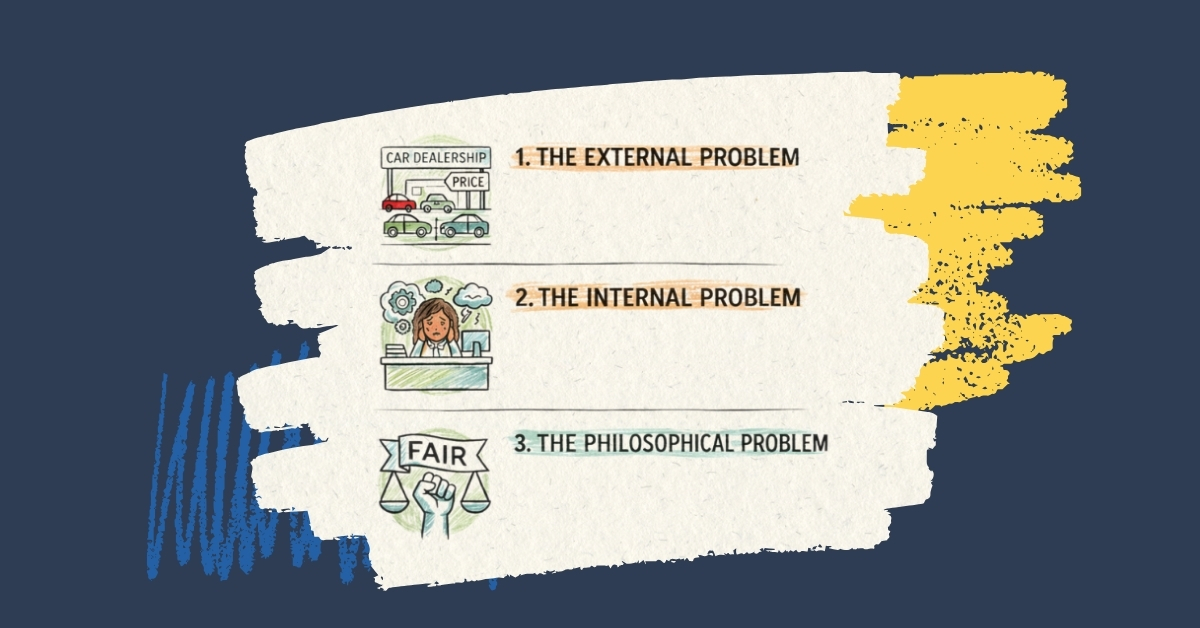
What he found is that most businesses misread their customer’s problem. They solve the obvious one and miss the two underneath it. His StoryBrand framework, laid out in Building a StoryBrand: Clarify Your Message So Customers Will Listen, identifies three levels of problem that every customer carries. Understanding all three changes how you communicate.
The external problem
This is the practical need. The thing the customer would say out loud if you asked them why they called.
Someone needs a car. That is the external problem. It is real, it is easy to name, and every dealership in the country is trying to solve it. Which is exactly the problem. When every competitor addresses the same obvious need, the conversation quickly turns to price.
Most marketing lives here. It describes the service, lists the features, and competes on the surface. It’s not wrong, but it is incomplete.
The internal problem
Underneath the practical need is something the customer rarely says out loud.
The person buying a car is not just thinking about reliability or monthly payments. They are thinking about the last time they sat across a desk from a salesperson and felt like they were losing. The anxiety that comes with not knowing whether the price is real. The suspicion that someone is working an angle.
That feeling is the internal problem. It is emotional, often unspoken, and almost always more powerful than the practical need above it.
Businesses that speak to this layer connect differently. The customer feels understood.
The philosophical problem
The deepest level is a belief about how things should work.
A woman walking into a dealership alone should not have to wonder whether she is being taken seriously. She should not have to bring someone with her to feel like she has a fair shot. More than a feeling, she holds a conviction about basic fairness.
CarMax built its entire model around this. No-haggle pricing. Transparent numbers. A process designed so that no customer, regardless of who they are or who they came with, starts at a disadvantage. They did not just solve the external problem of needing a car. They named the internal anxiety and stood against the philosophical wrong.
That is why people trust them before they ever set foot on the lot.
What this means for your business
Most businesses can name their customer’s external problem without thinking. There is a massive opportunity in asking what the customer is actually feeling when they reach out. Fewer still have asked what their customer believes should be true about how this kind of work gets done.
Those two questions are worth spending time on. Not as a branding exercise, but because the answers change what you say and how you say it. A message that only addresses the practical need sounds like every competitor. A message that speaks to the feeling and the belief sounds like someone who actually understands.
The StoryBrand framework and book are the clearest guide to this approach written specifically for small business owners. If you work with clients who have to trust you before they hire you, it is worth reading.
Your turn, your 20-minute task
Pick one service you offer and write three sentences, one for each level. What is the practical problem your customer is trying to solve. What are they feeling when they decide to reach out. What do they believe should be true about how this kind of work gets done. Do not use your current website language. Write it fresh. When you have all three, read them together and ask whether your homepage reflects any of them.
If this raised questions about your own marketing, please reach out at info@hookstrategic.com. We’re glad to talk through it.